
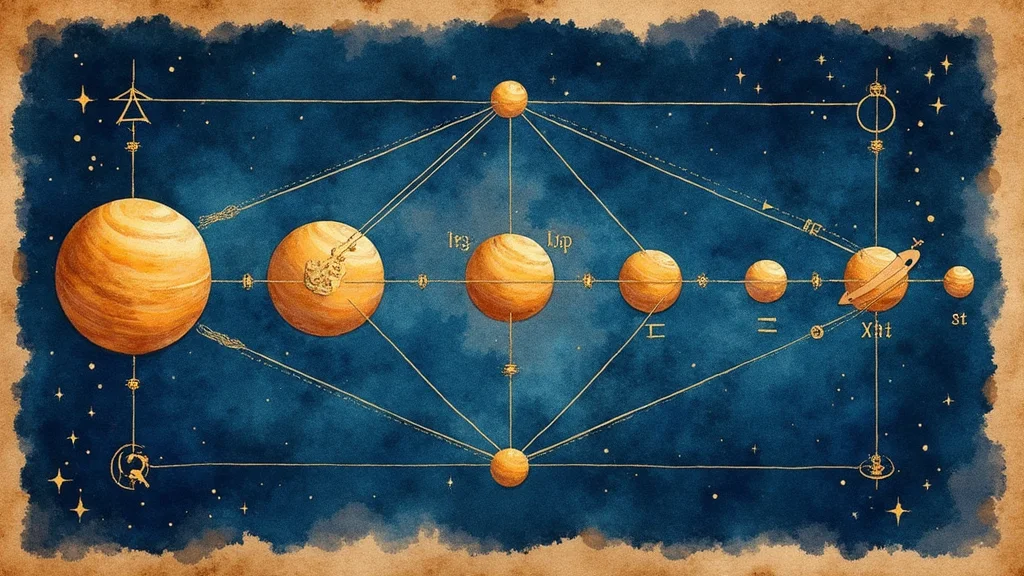
When you look at a birth chart, the planets scattered around the wheel aren't just sitting there independently. They're in constant conversation with each other — and the language they use is geometry. The angles they form, called aspects, tell you whether two planetary energies are blending smoothly, working together, locking horns, or pulling in opposite directions. Understanding aspects means understanding how the different parts of you relate to one another.
In This Article
Think of your chart as a cast of characters — the Sun, Moon, Mercury, Venus, Mars, and the rest. Each one has a distinct personality and job to do. Aspects are what happen when two of those characters share the same stage. Depending on the angle between them, they might be finishing each other's sentences, or they might be constantly stepping on each other's lines.
Conjunction — Fusion and Intensity
A conjunction happens when two planets occupy nearly the same degree of the zodiac — zero degrees apart. The energies don't just meet; they merge. There's no separation between them, which makes this one of the most powerful aspects in any chart.
It's not automatically harmonious, though. When two planets fuse, their combined energy becomes concentrated and hard to separate. If you have the Sun conjunct Mercury, for example, your thinking and your sense of self are thoroughly intertwined — you identify deeply with your ideas, and your communication feels personal. The blend amplifies both energies, and learning to work with that intensity is part of the story.
Sextile — Opportunity and Easy Cooperation
The sextile forms when two planets are about 60 degrees apart. It's a gentle, friendly aspect — the two planets support each other without any fuss. Where a trine brings gifts that come almost too naturally, the sextile asks for a small amount of effort before it pays off.
Venus sextile Jupiter is a good example. Venus rules affection, beauty, and pleasure; Jupiter expands whatever it touches. This pair creates an easy warmth and generosity in the personality, a talent for attracting good things and good people. You still have to reach out and use it — but when you do, it flows.
Square — Tension That Drives Growth
Two planets at a 90-degree angle are in a square — and yes, you'll feel it. These two energies are pulling in fundamentally different directions at the same time. It can feel like one foot on the accelerator and one on the brake, or like two internal voices that can't agree on anything.
Mars square Saturn is a classic example of productive tension. Mars wants to charge forward; Saturn wants caution and structure. Together they create constant internal friction — but that friction, worked with consciously, can produce real discipline and staying power. People with strong squares in their charts often accomplish things, precisely because they've had to fight for it.
Trine — Flow and Natural Talent
The trine is the aspect most astrologers describe as "lucky," and for good reason. When two planets are 120 degrees apart — especially in the same element — they understand each other intuitively. Their energies cooperate without effort.
Moon trine Neptune, for instance, blends emotional sensitivity with imagination in a way that feels completely natural. If you have this in your chart, you may have a deep artistic or empathic gift that you've always taken for granted — it's just part of how you're wired. That's the upside. The downside is that trines can breed complacency. When something comes easily, you don't always push it as far as it could go. Knowing your trines is knowing where you have raw material that deserves more investment.
Opposition — Polarity and Awareness
At 180 degrees, two planets are directly across the chart from each other — a full opposition. This is the aspect of push and pull, of two legitimate needs that seem impossible to satisfy simultaneously. The Sun opposing the Moon, for example, can feel like your conscious drive and your emotional instincts are always tugging in opposite directions.
But oppositions aren't just conflict. They're the aspect of awareness. Because the tension is so visible — you feel it, other people often reflect it back at you — oppositions eventually force you to develop perspective. You learn to hold both ends of the axis at once, and that balance becomes one of your real strengths. Relationships often activate oppositions in powerful ways, because we tend to attract people who embody the side of the axis we've been neglecting.
A Note on Orbs
Aspects don't have to be mathematically exact to count. The degree of tolerance allowed is called an orb. A conjunction is typically considered active within about 8 degrees either side of exact; a trine and square within 6–8 degrees; a sextile within 4–6 degrees. The closer to exact, the stronger the aspect. If two planets are 91 degrees apart, that's still a square — just a slightly looser one than if they were sitting at exactly 90.
Different astrologers use slightly different orb ranges, and there's no universal agreement. As a general rule, tighter aspects tend to feel more obvious and defining in the personality. Wide aspects are still there — they're just a little more in the background.
Hard Aspects Aren't Bad
A chart full of trines and sextiles isn't necessarily a happy life — it can just as easily be a comfortable one that never gets tested. Squares and oppositions are where character is built.
There's a persistent misconception in pop astrology that "easy" aspects (trines, sextiles) are good and "hard" aspects (squares, oppositions) are bad. That's too simple. Hard aspects generate energy. They're the internal pressure that pushes you to develop skills, work through contradictions, and grow in ways you wouldn't if everything came easily.
Some of history's most driven and accomplished people have charts loaded with squares and oppositions. The challenge isn't the aspect itself — it's whether you meet it consciously or let it run on autopilot. If you want to go deeper on this, the article Understanding Squares and Oppositions covers the mechanics and real-life dynamics of hard aspects in much more detail.
See Your Aspects in Action
Reading about aspects in the abstract only gets you so far. Your chart has its own specific web of them — some tight and defining, others wide and subtle, each one a conversation between two parts of who you are. The aspects between your Mars and Saturn are different from someone else's; your Venus trines and Mercury squares are uniquely yours.
Create your free natal chart on AstroKalhas to see every aspect in your chart laid out clearly, with the degrees, symbols, and the planets involved. Once you know what's in conversation in your chart, a lot of things about yourself start to make a lot more sense.
No comments yet. Be the first to comment!