Astrology didn't stop the moment you were born. Right now, the planets are moving through the sky — and as they do, they're bumping into, triggering, and activating the planets in your natal chart. That's what a transit is: the live sky talking to your frozen birth chart.
In This Article
Two Charts, One Moment
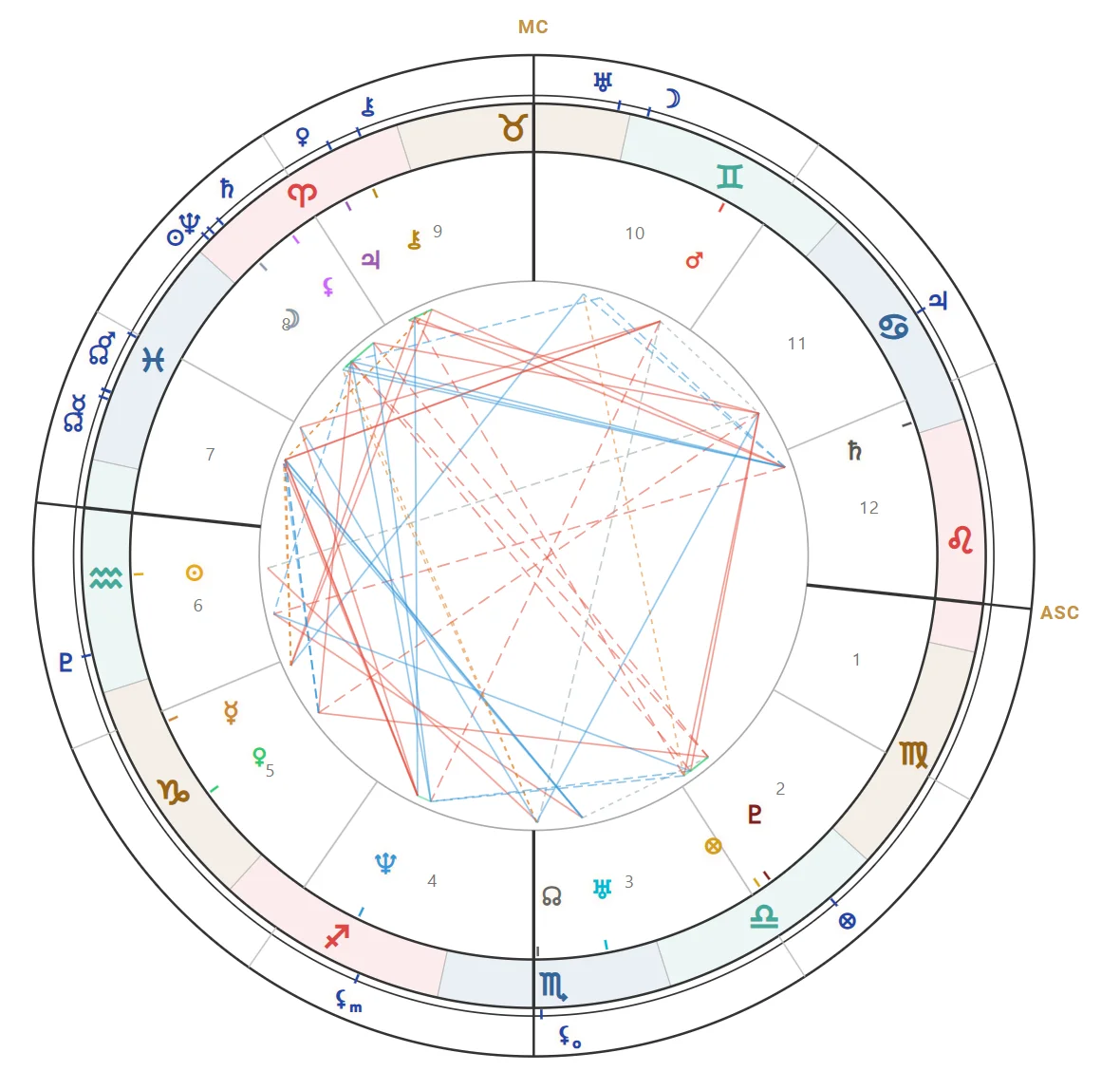
Think of your natal chart as a photograph — a perfect still image of the sky the instant you arrived in the world. Every planet locked in place, every house set, every angle fixed. That chart doesn't change. Ever.
Transits are what happens when the current sky — today's planetary positions — gets laid on top of that photograph. Where today's Saturn falls over your natal Moon, where today's Jupiter lines up with your natal Venus, which house the transiting Sun is currently moving through: that's your transit picture for right now.
It's the most basic tool for understanding why things feel different from one week to the next even though "you" haven't changed. The backdrop has shifted.
Your natal chart is who you are. Transits are what life is asking of you right now.
Fast Planets, Slow Planets
Not all transits are created equal. The speed of a planet determines how long it stays in conversation with your chart — and how deeply it registers.
The Moon is the fastest thing in the sky — it changes sign every 2.5 days. A Moon transit over your natal Mars might leave you feeling edgy or productive for a day and then it's gone. You probably won't remember it next week. These quick passes are useful for timing small events or explaining a mood, but they rarely change the course of your life.
Mercury, Venus, and Mars move faster too — weeks to a couple of months. Mercury transits tend to stir up communication and information. Venus transits often coincide with social ease, spending, or relationship activity. A Mars transit can push energy your way, or friction, depending on the aspect.
Jupiter and Saturn are where things get serious. Jupiter takes about 12 years to circle the chart, spending roughly a year in each sign. Saturn takes 29 years. When either of these is in a strong aspect to one of your natal planets, you'll feel it for months — sometimes the better part of a year. These are the transits that tend to mark real chapters of your life: a promotion, a move, a difficult stretch of self-reckoning, a period of expansion.
Uranus, Neptune, and Pluto operate on an entirely different scale. Uranus takes 84 years to complete one orbit. Neptune takes 165. Pluto, 248. When one of these outer planets forms a major aspect to something sensitive in your natal chart, it can stay within orb for years — even returning multiple times due to retrograde motion. These transits don't just describe events; they reshape you.
What Aspects Actually Mean
The word "transit" on its own doesn't tell you much. What matters is the aspect — the geometric angle between the transiting planet and your natal planet. Is the current Saturn sitting directly on top of your natal Moon (a conjunction)? Ninety degrees away from it (a square)? Forming a flowing trine?
Conjunctions are the most direct: two energies meeting at the same point. Oppositions create tension between two sides of your life. Squares push and challenge. Trines and sextiles tend to flow more easily, opening doors rather than forcing them.
A few examples bring this to life quickly:
- Saturn conjunct natal Moon — Saturn pressing directly onto your natal Moon is one of the heaviest emotional transits. You might feel burdened, emotionally flat, or held to account for how you've been managing your inner life. It's rarely comfortable, but people often look back on it as a time they genuinely grew up in some way.
- Jupiter trine natal Venus — This is the kind of transit that makes social life feel effortless. New connections arrive. A relationship deepens. Money flows more easily. You feel likable and generous. It doesn't last forever, but it's a great window for putting yourself out there.
- Uranus square natal Sun — A prolonged square from Uranus to your natal Sun tends to shake loose whatever has become too rigid in your identity. Career upheaval, sudden restlessness, the urge to break out of expectations. It can feel chaotic, but it's often how people find out what they actually want.
Retrogrades: A Second Look
Every planet except the Sun and Moon goes retrograde periodically — meaning it appears to move backward through the zodiac from our vantage point on Earth. This isn't real backward motion; it's an optical effect based on the relative speeds of Earth and the other planets. But the timing matters in transit work.
When a planet goes retrograde while it's in aspect to one of your natal planets, that aspect can repeat two or three times instead of once. Saturn might cross your natal Moon in the autumn, station retrograde, cross back over it in winter, turn direct, and cross it a final time in the spring. That's nearly a full year of Saturn-on-Moon energy revisiting the same theme in different emotional registers — raw first pass, deeper reckoning in retrograde, then some kind of resolution on the direct pass.
Watch for these triple transits. They tend to be the ones that stick.
See It for Yourself
Reading about transits is useful. Watching them happen is something else entirely. AstroKalhas has a Transit Animator that places today's planetary positions directly over your natal chart — in real time, with full aspect lines drawn in.
You can slow it down, speed it up, step forward or backward through time. Watch Saturn approach a sensitive point in your chart. See how long Jupiter lingers in a particular house. Spot a retrograde triple-pass before it unfolds.
If you've ever wondered why a certain period of your life felt so charged while another felt flat, the Transit Animator will usually show you exactly why. Pull up your chart and take a look.
No comments yet. Be the first to comment!