
Every year, on or within a day of your calendar birthday, something quietly remarkable happens in the sky. The Sun returns to the exact same degree and minute it occupied the moment you were born. Astrologers cast a chart for that precise instant — and that chart is your solar return.
In This Article
What Is a Solar Return?
Think of it as your astrological birthday. The Sun completes one full orbit of the zodiac each year, and when it hits the exact longitude it held at your birth — down to the arcminute — that's the solar return moment. It can fall on your actual birthday, the day before, or the day after, depending on the calendar.
The chart cast for that moment acts as a snapshot of the year ahead. It's valid from one solar return to the next, replacing itself each time the Sun comes home. Astrologers have used this technique for centuries; the 17th-century French master Morin de Villefranche wrote extensively about it, and it's still one of the most practical annual forecasting tools in the kit.
How It Differs from Your Natal Chart
Your natal chart is fixed — it never changes. It shows who you are: your Sun at a specific degree, your natal Moon in a specific sign, your rising sign set at birth. The solar return uses the same Sun degree (that's the trigger), but everything else shifts. The Moon will be in a completely different sign. The rising sign — the Ascendant — changes based on both the time of the return and where you are on the globe when it happens.
So while your natal Sun in Scorpio stays in Scorpio forever, your solar return chart for this year might have a Gemini Ascendant and a Moon in Capricorn. Same you, very different year.
The solar return doesn't override your birth chart — it works like a lens that focuses the year's themes through the permanent structure of who you are.
Key Elements to Read in a Solar Return
You don't need to analyze every planet in the solar return. A few key placements tell most of the story.
Beyond these four, you can layer in the chart ruler, any stelliums (clusters of three or more planets in one sign or house), and which natal houses are activated by the solar return planets. That's where the real texture emerges.
Why Your Location Matters
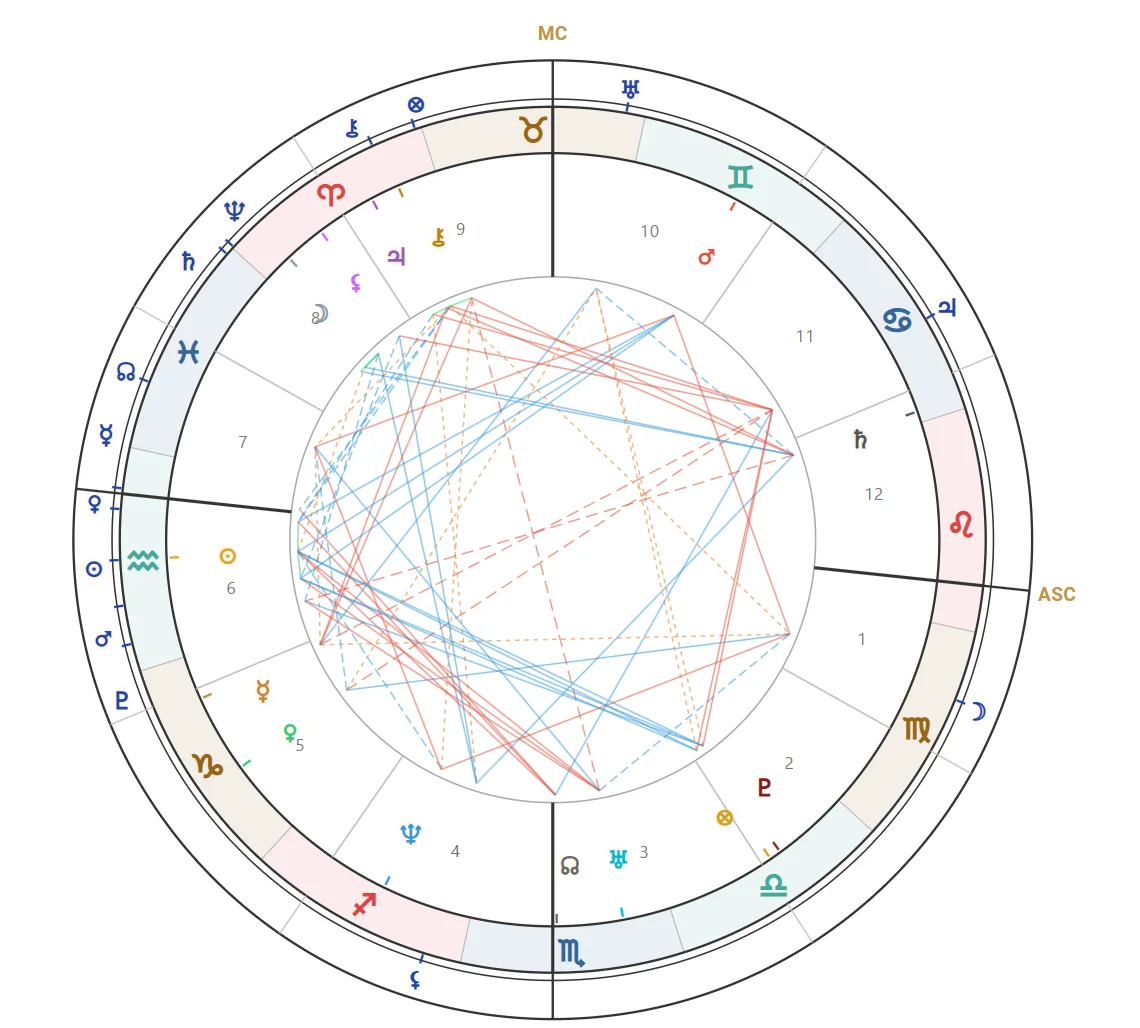
Here's something that surprises most people when they first hear it: where you are on your birthday changes the solar return chart. The moment the Sun returns is fixed — it's a global event. But the Ascendant and house cusps depend on your geographic coordinates at that moment. Travel 1,000 kilometers east, and your solar return Ascendant can shift by several signs.
Some astrologers take this seriously enough to travel — what's sometimes called "relocating your solar return." If your hometown gives you Saturn on the Ascendant this year and you'd rather have Jupiter there instead, a flight to the right longitude might do it. It's controversial in traditional circles, but many modern practitioners swear by it. At minimum, it's worth knowing that the chart you get at home is specific to that location, not universal.
How Solar Returns Work with Transits
A solar return doesn't stand alone. Think of it as a middle layer in a three-tier forecast. The natal chart is the foundation — your permanent architecture. Transits are the weather — what the planets are doing right now relative to your birth positions. The solar return sits between them, describing the year's broad territory before the day-to-day transits spell out the details.
A solar return theme gains power when it's echoed by major transits. Say your solar return has Jupiter in the 2nd House — that's a promising financial signal. If Jupiter is also transiting your natal 2nd House that year, the message is reinforced from two independent sources. When a chart point appears in both the solar return and the transits, pay close attention.
On AstroKalhas, the solar return report includes a bi-wheel overlay — your solar return chart placed around your natal chart so you can see exactly how the two interact. It's the clearest way to spot those double signals without doing the comparison mentally.
See What This Year Has in Store
Your solar return is already waiting. It was cast the moment the Sun came back to its birth degree this year — and everything in it is specific to you, your birthplace, and where you spent that birthday. Pull it up and see which house is getting the Sun's attention, what your emotional Moon is doing, and whether any planets are sitting right on the angles.
Generate your solar return chart on AstroKalhas and explore the full year ahead — bi-wheel included.
No comments yet. Be the first to comment!