
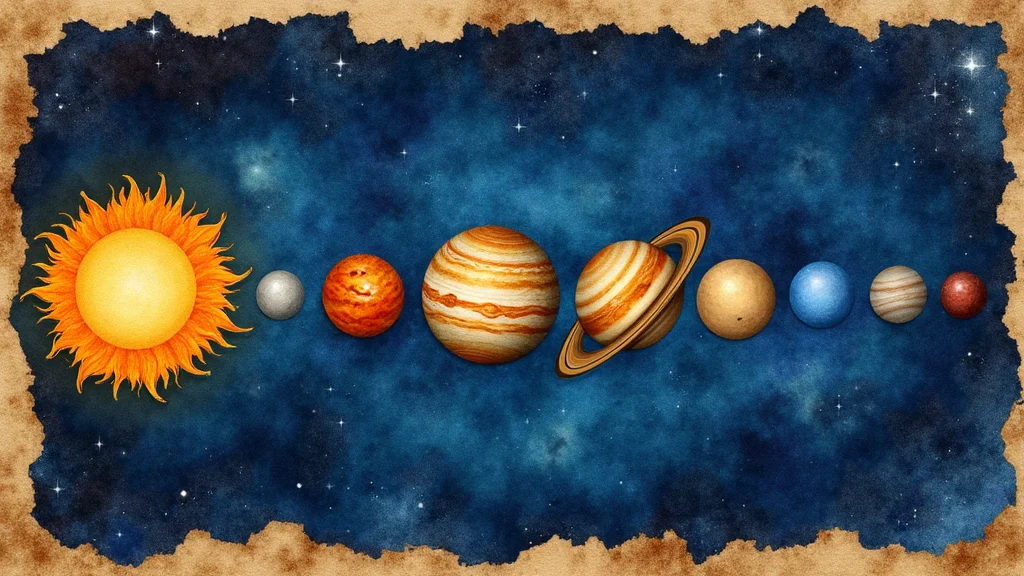
Think of your birth chart as a stage, and the planets as the cast. Each one has a specific role — a drive, a need, a piece of who you are. The signs tell you how they act, the houses show you where they act, but it's the planets themselves that tell you what's actually happening. Get to know them and your chart stops looking like a wheel full of symbols and starts making genuine sense.
In This Article
Personal Planets: The Inner Cast
The Sun, Moon, Mercury, Venus, and Mars move quickly through the zodiac, completing full cycles anywhere from a month to two years. Because they shift fast, they differ from person to person even among people born in the same year. These are the planets that shape your most immediate, personal experience — your mood, your voice, your wants, your drive.
The Sun
The Sun is the center of your chart for the same reason it's the center of the solar system — everything else orbits around it. It represents your conscious identity, the person you're actively trying to become, and the creative force that wants to shine. Your Sun sign is the one you look up in any horoscope column, though the full picture runs much deeper than that. Someone with the Sun in Scorpio, for instance, will have a driving need to understand things at the deepest level — surface answers genuinely frustrate them.
The Moon
If the Sun is who you're consciously trying to be, the Moon is who you are when no one's watching. It rules your emotional world — your gut reactions, what makes you feel safe, and the needs you carry from childhood that often go unexpressed. The Moon changes signs every two and a half days, making it one of the most personal points in a chart. A Moon in Capricorn might respond to stress by going quiet and working harder, while a Moon in Gemini needs to talk everything through to feel settled.
Mercury
Mercury governs the way you think, speak, write, and process information. It's not about how smart you are — it's about your mental style. Do you think in big-picture leaps, or do you need to check every detail before reaching a conclusion? Mercury in Sagittarius tends to speak before thinking and loves bold ideas, while Mercury in Virgo will dissect a problem carefully before saying a word. When Mercury turns retrograde three times a year, it's this planet's apparent reversal that prompts the well-known advice to back up your files and double-check your messages.
Venus
Venus shows what you find beautiful, what you desire, and how you attract and relate to others. It rules romantic love, yes, but also your aesthetic preferences, your relationship with money, and what gives you genuine pleasure. Venus in Taurus wants sensory comfort — good food, touch, and financial security feel like love to them. Venus in Aquarius expresses affection through ideas and independence, and may find clinginess deeply unappealing.
Mars
Mars is your engine. It rules how you take action, how you assert yourself, where your energy goes, and how you handle anger. If Venus is what you want, Mars is how you go after it. Mars in Aries charges ahead without hesitation, trusting instinct over strategy. Mars in Libra, by contrast, tends to deliberate, weigh every angle, and avoid direct confrontation — which can look like passivity but is really a different style of pursuit. Your Mars placement also speaks to your physical energy levels and how you handle competition.
The personal planets describe the person you experience yourself to be. The planets that follow describe the world you live in — and the invisible currents shaping your generation.
Social & Outer Planets: The Bigger Forces
Jupiter and Saturn move slowly enough that they're shared across several years of births — they mark generational tones as much as individual personalities. Uranus, Neptune, and Pluto move even more slowly, shaping entire eras. In your personal chart, these outer planets matter most through the houses they occupy and the aspects they make to your personal planets.
Jupiter
Jupiter is the planet of growth, abundance, and good fortune — but it's less about luck dropping from the sky and more about where you're naturally optimistic and willing to expand. It spends about a year in each sign, and whichever house it sits in shows an area of life where things tend to open up for you. Jupiter in the 2nd House often brings financial opportunity — but also the temptation to overspend. The catch with Jupiter is that its gifts can tip into excess: too much confidence, too many commitments, too grand a vision without grounding.
Saturn
Saturn has a reputation as the taskmaster of the zodiac, and it earns that title — but in the best possible way. It shows where you're being asked to develop real mastery through effort, patience, and sometimes difficulty. The house Saturn occupies in your chart is rarely easy, but it's often where your most enduring achievements come from. Saturn in the 10th House might mean a slower career climb than your peers, but the credibility you build is genuinely yours. The Saturn Return — when Saturn completes its cycle back to its natal position around age 28-30 — is one of astrology's most recognised life milestones.
Uranus
Uranus spends about seven years in each sign, so everyone born within that window carries its influence collectively. In your personal chart, the house Uranus occupies shows where you're prone to sudden disruptions, radical breaks, and unexpected breakthroughs — sometimes all at once. If Uranus touches your 7th House, for example, your relationship life tends to be unconventional or punctuated by unexpected turns. It's the planet that refuses to be boxed in, and it's associated with technology, rebellion, and anything that breaks the established pattern.
Neptune
Neptune takes about 14 years to move through a sign, so its sign placement speaks more to a generation's collective spiritual and cultural mood than to individual traits. In your chart, Neptune's house placement shows where reality can feel blurry — where you idealize, where you're prone to self-deception, and also where your most transcendent experiences live. Neptune in the 5th House might bring an artist of extraordinary imagination — or someone who consistently falls in love with people who don't quite exist. Its shadow is fog; its gift is vision.
Pluto
Pluto moves so slowly — taking 12 to 31 years per sign depending on its orbit — that its sign tells you almost nothing about you as an individual, but everything about your generation's relationship to power and transformation. In your chart, its house shows where life will likely put you through the fire — and where you'll come out fundamentally changed. Pluto in the 1st House shapes someone whose very identity undergoes radical reinvention across a lifetime. Its energy isn't subtle, and it rarely leaves things the way it found them.
A Note on the Lunar Nodes
Technically not planets, the North Node and South Node are the two points where the Moon's orbit crosses the ecliptic. They always sit opposite each other in the chart and are treated in astrology as indicators of karmic direction. The South Node points to patterns and strengths you came in with — what feels comfortable but may keep you stuck. The North Node shows the direction your soul is being pulled toward — unfamiliar territory that, when you lean into it, brings a sense of purpose. They move backward through the zodiac over an 18.6-year cycle, so your nodal axis connects you to everyone born around the same time.
Now that you know who the players are, the real question is where they're sitting in your chart. See exactly where your Sun, Moon, and all eight planets fall — and what that means for your life — by creating your free birth chart on AstroKalhas. It takes about two minutes, and the picture it paints is entirely your own.
No comments yet. Be the first to comment!