
Picture the sky at the exact second you were born. The Sun was somewhere in the zodiac, the Moon was somewhere else, and every planet was frozen in a specific position. A natal chart — sometimes called a birth chart — is a map of that frozen moment. It's not a prediction of your destiny. It's a description of the sky's geometry the instant you took your first breath, and it's unlike anyone else's on earth.
In This Article
A Snapshot, Not a Sentence
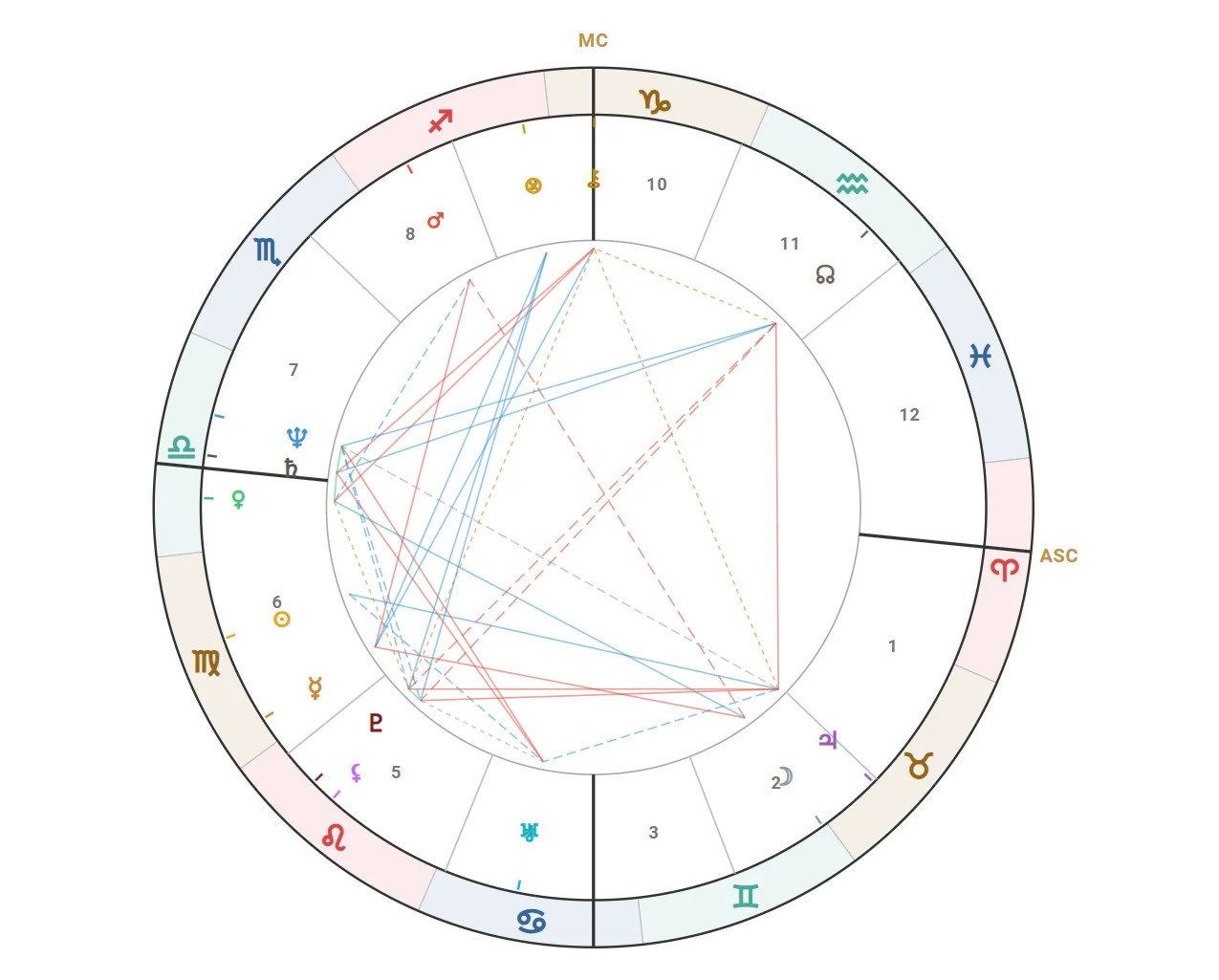
The word "natal" just means "relating to birth." So a natal chart is literally the birth chart — a circular diagram divided into twelve sections, with symbols scattered across it representing where each planet sat in the sky the moment you arrived. Astrologers use it the way a doctor uses a blood panel: not to tell you what will happen, but to understand your baseline constitution.
Two people born in the same city on the same day but four hours apart will have noticeably different charts. Birth time matters that much. It shifts the house positions significantly and can even change the rising sign entirely. This is why your birth chart is yours and nobody else's.
Your natal chart doesn't tell you who you have to be. It tells you what you came in with — the raw materials, the tendencies, the default settings you're working with.
The Planets: What Is Active in You
Think of the planets as the cast of characters in your psyche. Each one represents a specific type of drive or function. The Sun is your core identity — the thing you're growing into. The Moon is your emotional world, your instinctual reactions, the way you feel safe. Mercury is how you think and communicate. Venus is what you love and value. Mars is how you act and go after what you want.
Then there are the slower planets. Jupiter and Saturn shape the broader patterns of opportunity and discipline in your life. Uranus, Neptune, and Pluto move so slowly that they describe the themes of entire generations — but their house positions in your chart make them personal.
The Signs: How Each Planet Expresses Itself
If planets are the "what," signs are the "how." The sign a planet occupies describes the style, tone, and flavor with which that planetary energy comes through. Mars in Aries is direct, fast, and impulsive. Mars in Libra is deliberate, strategic, and prone to weighing both sides before acting. Same planet, very different expression.
There are twelve signs, each with its own quality, element, and mode. Aries, Leo, and Sagittarius are fire signs — energetic, enthusiastic, action-oriented. Taurus, Virgo, and Capricorn are earth signs — practical, grounded, concrete. Gemini, Libra, and Aquarius are air signs — intellectual, social, communicative. Cancer, Scorpio, and Pisces are water signs — emotional, intuitive, depth-seeking.
Your Sun sign — the one you probably know already — is just one piece of this. Your Moon might be in a completely different element, your rising sign in yet another. That's why two Virgos can feel so different from each other. The whole chart tells the full story.
The Houses: Where Life Plays Out
The twelve houses divide the chart wheel into zones of life experience. The 1st House is about your identity and physical appearance — how you show up in the world. The 4th House rules home, family, and roots. The 7th House covers partnerships and committed relationships. The 10th House is career, public reputation, and your role in society.
When a planet falls in a particular house, that's where you feel its energy most directly in daily life. Saturn in the 7th House suggests relationships that come with serious work or arrive later in life. Venus in the 2nd House connects your values and pleasures closely to money and material comfort. Houses bring the abstract down to earth.
Planets are the players. Signs are how they behave. Houses are the stage they're performing on. You need all three to understand the full scene.
Aspects: The Conversations Between Planets
Planets don't just sit in isolation — they form geometric angles to each other, and those angles create energy dynamics called aspects. A conjunction (planets close together) blends their energies intensely. A trine (120° apart) creates flow and ease between them. A square (90° apart) generates friction and challenge — which often produces some of your strongest growth.
Aspects are the connective tissue of the chart. They show which parts of your personality are working in natural harmony, and which are in productive (or not-so-productive) tension. A person with a Sun–Moon trine tends to feel more internally unified than someone with a Sun–Moon square, who may experience a persistent conflict between their conscious goals and their emotional needs.
What You Need to Get Your Chart
To calculate an accurate natal chart you need three things: your birth date, your birth time (as precise as possible — the minute matters), and your birth location (city and country). The time determines your rising sign and house placements, so if you're not sure, check your birth certificate or ask a parent.
If you genuinely can't find your birth time, you can still cast a chart using noon as a default — you'll lose the house axis and rising sign accuracy, but the planetary sign placements will be correct for most of the day. Some astrologers also specialize in a technique called chart rectification that can estimate the birth time from life events, but that's a conversation for another article.
Once you have those three pieces, calculating the chart takes seconds. The interpretation is where the depth comes in — and that's where AstroKalhas can help. You can generate your full natal chart on this site for free, with a detailed breakdown of every planet, sign placement, and house position. If you want to go deeper, the Pro reports offer extended interpretations covering everything from personality to life themes to timing.
Your chart has been waiting since the moment you were born. Go find out what it says.
No comments yet. Be the first to comment!