
Precautions - Superstitions
SUPERSTITION = From "deido" (I fear) + "daimon" (god) = An irrational fear of evil spirits, of supernatural forces.
PRECAUTION = "Pro" + "lambano" (I take) = 1. Removal, obstruction. 2. Superstition, prejudice.
PREVENTIVE = 2. Someone who contributes to preventing the creation or manifestation of an undesirable situation.
SUPERSTITION This term describes any act or belief with a magical or religious character that exists outside or in opposition to the official religion of a social group. However, the concept is relative, as it is based on the official religion of the group at the time. For example, Christianity was initially viewed as a superstition by older pagans, who, with excessive zeal, persecuted and condemned its followers. These acts and beliefs are typically remnants of earlier stages of culture and religion, which have often been modified so much that they have lost any direct religious connection. This is why superstitions are less common in cultures that do not have earlier stages of cultural development, or where such beliefs have little or no significance. Many customs, morals, and traditions, deeply ingrained, have been absorbed into the official religion and incorporated into its rituals, such as processions and amulets. When we talk about superstitions, we are essentially talking about attributing supernatural power to objects, actions, words, or even people. Superstitions can be divided into religious and magical superstitions. Religious superstitions include various types of exorcisms that invoke the names of God, the Virgin Mary, saints, etc., while magical superstitions attribute either beneficial or harmful power to objects, words, or actions. For example, the belief in demonic entities originates from an ancient animistic perception (panpsychism), while the belief in the evil eye, spells, etc., stems from the power of healers and magicians, which refers to the beginning of human creation, where ignorance and fear of natural phenomena give rise to these beliefs. SUN Opinion that is not based on logic but is formed arbitrarily by various causes or coincidences. They arose from the human need to ensure a smooth life, to prevent impending harm, and to avoid unpleasant and painful situations that they saw happening around them. Behind all of this lies fear, a fear that stems from the inability to initially understand and explain natural phenomena that plague them, and so they attribute them to supernatural forces, gods, demons, etc. Over time, however, as they are passed down from generation to generation, they become habits, customs, and traditions, and take the place of a moral code that, if not followed, will bring punishment and harm to the individual and the family. However, one must question to what extent the various forms of power, starting from the shaman-healer, the priesthood, and reaching the present era, have cultivated such a climate to manipulate the people and direct them according to their own interests. How much do they exploit ignorance, naivety, and gullibility? Ultimately, how much are they used deliberately as a form of propaganda? Regardless of whether we reject them with logic, I believe that precisely because they have been passed down from generation to generation through words and actions, they have entered our subconscious and to some extent determine our actions. Many have been passed down in proverbs and sayings. And while they were created to serve a specific need in a specific era, they continue to exist today, even though they are no longer needed. For example, "The people of Chios go in pairs." Distortion of the truth, either due to ignorance, semi-knowledge, or intention. As long as we believe that the events of our lives depend not on our own efforts and abilities, but on external forces, there will be a basis that allows superstitions, superstitions, and other related things to enslave us and lead us to inactivity, and consequently to unpleasant events and situations. If humans operated solely on pure logic, there would be no problem, but there are feelings and emotions, and these try to compensate. Thus, they hope to free themselves from anxiety, uncertainty, and a sense of inadequacy, that is, that their knowledge and abilities are not sufficient to cope with the difficulties or to control the influences of their environment that are not pleasing to them.
A form of energy in the form of electromagnetic waves emitted by humans.
Superstitions and beliefs develop and spread mainly in times when power and authority are concentrated in the hands of a few who have the power of life and death over others. This naturally leaves no room for education, intellectual development, or even scientific research, such as in the Middle Ages, the Inquisition, Galileo, etc. As a form of resistance, a way to hold onto something, since they cannot be protected from the uncontrolled ruler, people turn to metaphysics, which then becomes entwined with religion, and thus myths, traditions, and customs are born. In Greece, they were mainly cultivated during the Ottoman period. However, behind many of these superstitions lies a fundamental need related to the individual's very survival, a need that arose in a specific era and under specific conditions. For example, a visitor should leave the house through the same door they entered to avoid ruining a potential marriage. The truth is very different. Houses had double and triple entrances, were built next to each other in narrow alleys, and this was a way to smuggle out children or even adults when child abduction occurred, and they didn't want outsiders to know about this possibility. In the Ottoman era. In the modern era, the rapid development of technology, the dismantling of old values and ideals, the attempt to create new ones, and the anxiety for professional and social success clearly push people to cling to something that will protect them from unpleasant and overwhelming surprises that life has in store for them.
Ottoman-Era Examples
The article above mentions that many Greek superstitions were cultivated during the Ottoman period. Here are two prominent examples that illustrate how historical trauma and cultural exchange gave rise to beliefs that persist to this day.
Tuesday the 13th
While much of the Western world dreads Friday the 13th, Greeks consider Tuesday the 13th the unluckiest day on the calendar. On this day, many avoid major decisions: they will not get engaged, start a new job, sign contracts, or travel. Some refuse to even cut their nails or hair. The superstition is directly tied to the Fall of Constantinople on Tuesday, May 29, 1453, when Sultan Mehmed II's forces breached the walls after a 53-day siege, ending the Byzantine Empire. Emperor Constantine XI Palaiologos died fighting in the city streets, and nearly four centuries of Ottoman rule began.
The connection deepens through numerology: the digits of 1453 sum to 13 (1+4+5+3=13), fusing the misfortune of Tuesday with the ominousness of the number 13 into a single superstition. Tuesday in Greek is "Triti" (Τρίτη), meaning "the third day," and bad luck is traditionally said to come in threes. The day is also associated with Ares (Mars), the god of war, adding a destructive connotation. This superstition remains widely observed in modern Greece — media regularly runs features about it, and many Greeks, even those who consider themselves non-superstitious, will hesitate before scheduling important events on a Tuesday the 13th.
The Evil Eye (Mati)
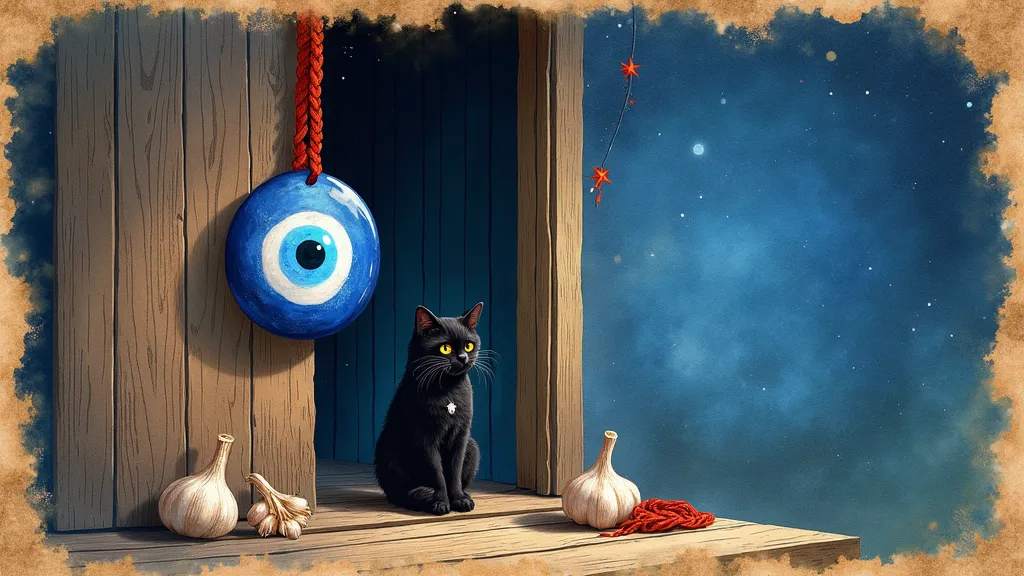
The "mati" (μάτι, meaning "eye") is the belief that an envious or admiring gaze can cause harm, illness, or bad luck. Protection takes several forms: wearing blue glass eye-shaped amulets, performing the "ftou ftou ftou" (φτού φτού φτού;) spitting gesture three times, and the secret "xematiasma" (ξεμάτιασμα) prayer ritual. In this ritual, a healer — usually an older woman — silently recites a secret prayer while dropping olive oil into water. If the oil disperses, the person is confirmed to have the evil eye, and the prayer removes it. The prayer must be passed down across genders (grandmother to grandson, or grandfather to granddaughter), or it loses its power.
While the concept of the evil eye is ancient, the iconic blue glass amulet — concentric circles of dark blue, white, light blue, and black — is a product of Ottoman-era cultural exchange. Ottoman glassmakers, particularly in Izmir and Anatolia, perfected the "nazar boncugu" using cobalt-blue glassblowing techniques. During centuries of coexistence under Ottoman rule, Greeks adopted these mass-produced beads as their primary form of protection, replacing older Byzantine-era charms. The blue color carries special significance: blue eyes were rare in the Eastern Mediterranean, and people with light-colored eyes were believed more capable of casting the evil eye. A blue eye amulet was thought to deflect the gaze back. Today, the mati remains one of the most visible superstitions in Greece — blue eye amulets are pinned to newborn babies, hung in cars and above doorways, and worn as jewelry, while the xematiasma prayer continues to be secretly passed down through families.
No comments yet. Be the first to comment!