
ASTRONOMY
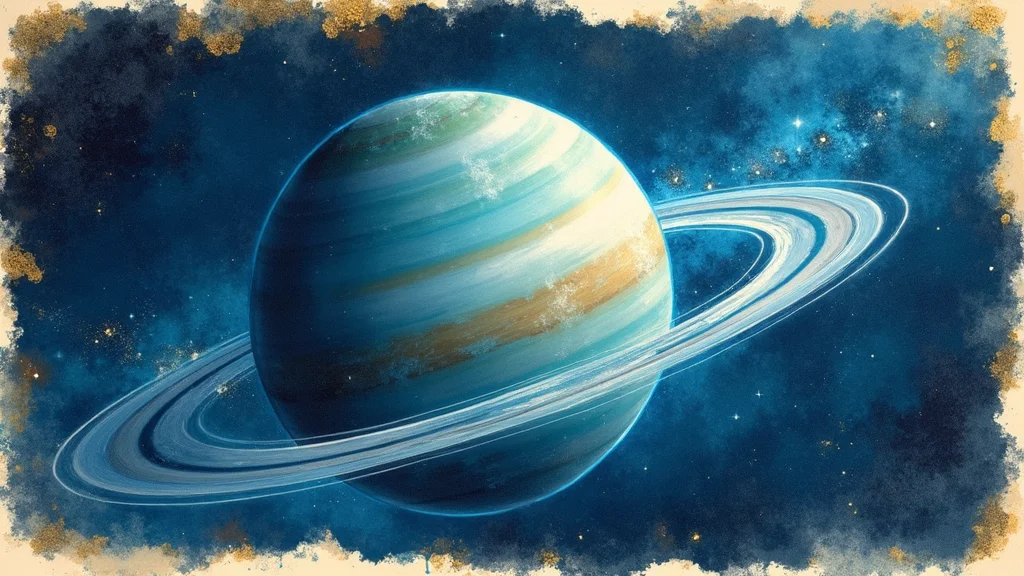
The seventh planet from the Sun in our solar system, it is the third largest in size. Uranus was officially discovered by the English astronomer William Herschel on March 13, 1781. However, there are earlier references to the planet, such as those by Flamsteed in 1690 and Mayer on September 26, 1756, who described it as a faint star. Subsequently, F.B. Herschel described it as a peculiar comet without a tail and named it <<Georgium Sidus>>, meaning 'Star of Saint George'. Eventually, it was classified as a planet by Barnabas Oriani in 1785. To the naked eye, it appears as a star of magnitude 6, while through a telescope, it resembles a small, bright disk with a blue-green to gray color. It is named after a figure from Greek mythology, due to its position after Saturn, as the father of Cronus. Its orbit around the Sun takes 84.015 (30.686 solar days) Earth years, while its diameter is four times the diameter of Earth, which is 51,800 kilometers. Its volume is also 64 times larger than the volume of Earth. It is approximately 3 billion kilometers from Earth. Its movement is unique compared to other planets, as its axis of rotation is tilted at an angle greater than 90 degrees, reaching 98°. The rotation of Uranus around its axis has an average period of 10 hours and 48 minutes and occurs in a retrograde direction, a phenomenon observed only in Uranus and Venus. This means that, while most planets rotate around their axis in the same direction as their orbit around the Sun (from west to east), Uranus and Venus rotate in the opposite direction. Furthermore, its axis of rotation lies almost in the plane of its orbit, causing the planet to alternately point its pole and its equator towards Earth as it orbits the Sun. This phenomenon is unique in our solar system, as the axes of rotation of the other planets are approximately perpendicular to the plane of their orbits. So far, this phenomenon remains peculiar and unexplained. The conditions on its surface are unusual and unique. Its seasons last 21 Earth years and are very pronounced. It is estimated that there is <<night>> for the corresponding period at both poles. It is in a gaseous state and covered by a semi-fluid crust. The temperatures on its surface reach -193 degrees Celsius, while the winds blow at speeds of up to 90-360 miles per hour. The atmosphere of Uranus is composed of 83% hydrogen, 15% helium, 2% methane, and small amounts of acetylene. The methane in the upper atmosphere is responsible for the planet's blue-green color, as it absorbs red light. The chemical composition of Uranus's atmosphere is similar to that of Jupiter and Saturn. Ariel, Umbriel, Titania, Oberon, and Miranda are some of its 21 moons, which orbit in a retrograde direction at the level of the equator and therefore at an angle of 98° to the orbital plane of the planet. Unlike the other planets and moons in our solar system, they are named after characters from the works of William Shakespeare and the English satirical poet Alexander Pope.
Titania and Oberon, the two largest moons, have a diameter of approximately 1,600 kilometers. This corresponds to about half the size of the Moon, while Miranda, the smallest, has a diameter of only 500 kilometers, which is 1/7 the size of the Moon. According to measurements made by Voyager 2, the larger moons are composed of 50% ice, 20% carbon and nitrogen compounds, and 30% rock. Their surface is a dark gray color, with numerous craters and deep canyons, reaching depths of up to 20 kilometers. In some areas, there are indications of geological activity within them. In 1977, nine thin rings surrounding Uranus were discovered, near its equator, and were named 6,5,4, Alpha, Beta, Eta, Gamma, Delta, and Epsilon. These rings were later photographed and measured by the Voyager 2 spacecraft, whose approach to Uranus began on November 4, 1985, and reached its closest distance on January 24, 1986, at 9:59 AM. On January 24, the Sun is in the zodiac sign of Aquarius. These rings are not as impressive as those of Saturn and Jupiter. The outermost ring, Epsilon, is composed of large pieces of ice and has a gray color. There is a significant number of narrow or incomplete rings, with different sizes, from 50 meters to larger, and there is plenty of dust among them. -----photos from the Internet. In total, there are 11 rings around Uranus.
A planet like Uranus could not have been discovered by an ordinary scientist. William Herschel, who discovered Uranus, was not an astronomer at all. He was a professional musician who studied mathematics, astronomy, and languages as a hobby.
MYTHOLOGICAL
According to Hesiod, in the beginning, there was Chaos, a vast space that contained, in potential form, all the elements that would compose the universe. From Chaos emerged Erebus, the dark space below the Earth, and Night. Erebus and Night gave birth to Aether, the eternal air that surrounds the world, and Day. Following this was Gaia, the world mother and source of life, who gave birth to Uranus, the starry vault. Then, Uranus joined with Gaia, his mother and wife, and thus, the world was created. The first generation of gods, the Titans, the Cyclopes, and the Hecatoncheires, were the product of this union. Specifically, twelve Titans, six male and six female: Oceanus, Coeus, Crius, Hyperion, Iapetus, and Cronus, and Tethys, Theia, Themis, Mnemosyne, Phoebe, and Rhea. Also, three Cyclopes, the one-eyed beings Brontes, Steropes, and Argus, who symbolize thunder, lightning, and the thunderbolt, and three Hecatoncheires, the mythical creatures with one hundred hands and fifty heads, Agaeon or Briareus, Cottus, and Gygies. However, the time came to end this union, so that the world could achieve stability and order and balance could develop in the universe, something that would not happen in a continuous process of creation. Under the influence of the mother Gaia, who was tired of the constant birth of children, but also of the lack of recognition from her father Uranus, Cronus cut off Uranus's genitals with a sickle that Gaia herself had made. From the blood of Uranus, which later spilled, were born the Erinyes, the Giants, and the Melian Nymphs, deities associated with revenge and pain. From the foam that was created when Cronus threw Uranus's severed member into the sea, Aphrodite was born. Uranus survived this ordeal, although his role later became limited. However, he retained an important privilege: the ability to foresee the future. Thanks to this, he would later be able to intervene to save his grandson Zeus and prevent his overthrow.
Diodorus Siculus presents a different version of the myth. According to him, Uranus was the first king of the Atlanteans, a just and pious people who lived on the shores of the Ocean. He was the one who taught them civilization and introduced them to spiritual life. An excellent astronomer, he observed the movements of the stars, created the first calendar, and predicted important events for the future. After his death, he was given divine honors and gradually identified with the sky itself. In this version, forty-five children are attributed to Uranus, eighteen from Tethys, who was later named Gaia. The Titans owe their genealogical name to their mother. Basileia, Kybele, and Rhea, who was later renamed Pandora, are considered daughters of Uranus. Basileia, exceptionally beautiful, succeeded Uranus on the throne and married Hyperion, one of her brothers. From this union, the Sun and the Moon were born. Among the children of Uranus are also Atlas and Cronus, according to Diodorus, while according to Plato, Oceanus and Tethys are also children of Uranus.
A slight variation of the original Greek myth appears in the Syrian tradition. Philo, in his writings, mentions that Cronus, son of Uranus, with the advice of Hermes Trismegistus, removed the generative power from his father with the help of his brothers, Betylus, Daguna, and Atlas.
Written by Dimitra Togka, Astrologer
No comments yet. Be the first to comment!